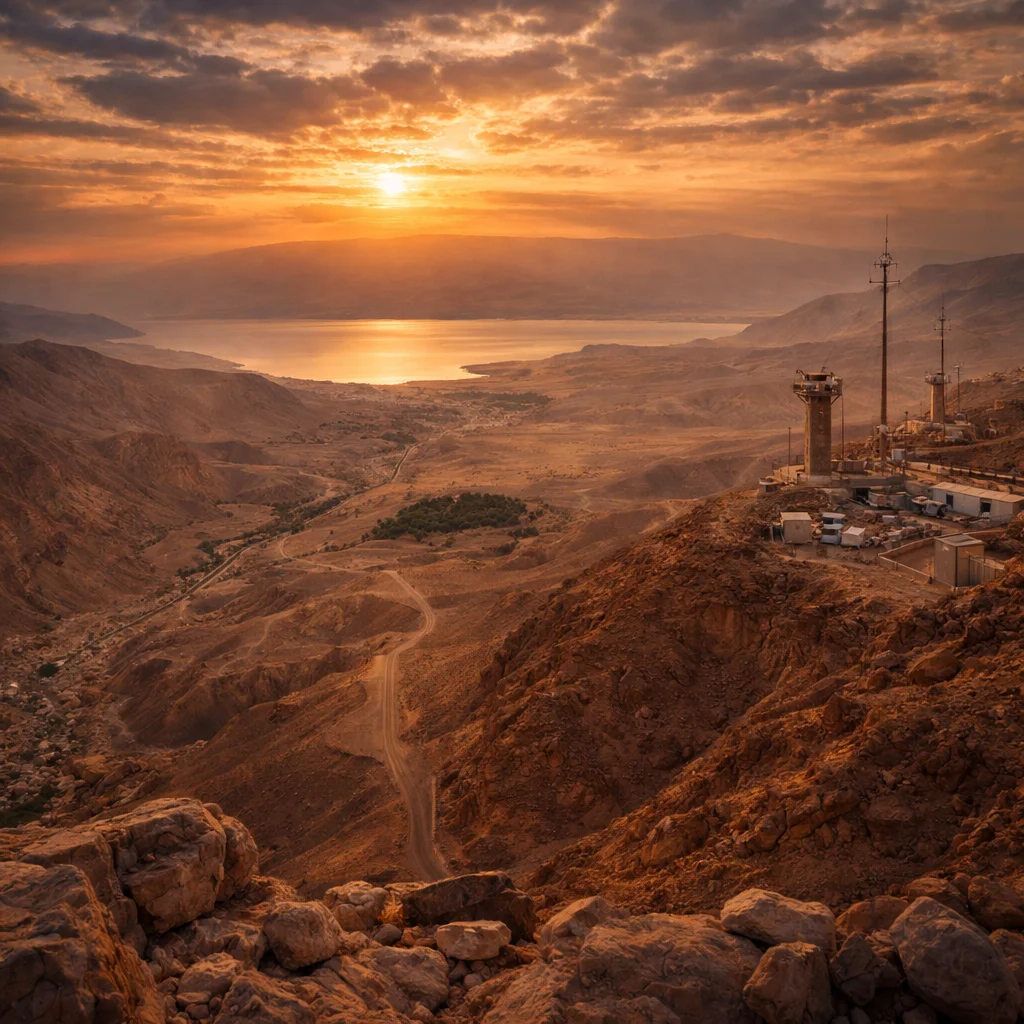
The Judean Desert looks empty on the map. Beige. Broken. Sparse.
But in Israel, emptiness is rarely neutral. The Judean Desert is not just a stretch of arid land east of Jerusalem. It is a place where geography, religion, security, media narratives, and modern logistics collide — quietly, without spectacle.
This desert does not announce itself. It works through pressure.
Geography That Refuses Comfort
The Judean Desert stretches from the eastern slopes of Jerusalem down toward the Dead Sea. The elevation drops sharply. Climate shifts fast. Rain is scarce, flash floods are sudden, and temperatures swing dramatically between day and night.
There is no gradual transition here.
Urban order ends abruptly. The desert begins immediately.
This physical harshness explains why the area has always been associated with testing — of bodies, beliefs, and systems.
Not a Void, but a Corridor
Despite its reputation, the Judean Desert has never been unused.
Historically, it functioned as:
- a refuge for religious communities,
- a hiding place during revolts,
- a corridor between Jerusalem and the Jordan Valley,
- a buffer zone in modern security planning.
Today, it remains a strategic depth area, not because of population density, but because of its positioning between political, religious, and military fault lines.
Religion Without Decoration
The desert’s religious significance is not ceremonial. It is functional.
Monasteries, caves, and ruins across the Judean Desert reflect a tradition of withdrawal, not expansion. People came here historically to reduce noise — social, political, spiritual.
This is why the desert appears constantly in religious texts as a place of preparation, not resolution.
Nothing is solved here. Everything is stripped down.
Modern Israel and the Desert Reality
In modern Israel, the Judean Desert sits uncomfortably close to decision-making centers.
Jerusalem is minutes away. Major roads cut through the terrain. Military zones, nature reserves, Bedouin encampments, and archaeological sites overlap — sometimes without clear boundaries.
This creates friction.
Planning in the Judean Desert is never purely environmental or economic. Every decision carries:
- security implications,
- international visibility,
- media sensitivity.
News platforms such as https://israeli-news.nikk.co.il/ regularly cover incidents in or around the desert not because of scale, but because small events here resonate loudly.
A minor road closure.
A protest near a settlement.
A rescue operation after a flash flood.
In this region, context magnifies everything.
Infrastructure in an Unforgiving Space
The Judean Desert exposes infrastructure weaknesses faster than almost any other region in Israel.
Roads erode quickly. Communication signals drop. Emergency response time matters more because distances feel longer under extreme conditions.
This is why modern Israeli planning increasingly relies on digital coordination and real-time systems — mapping, logistics, media distribution, and crisis communication.
Agencies like https://nikk.co.il/ do not work with geography in the abstract. Digital infrastructure exists to compensate for physical limitations — especially in regions where access is unpredictable.
The desert forces efficiency.
Media Representation vs. Physical Reality
Internationally, the Judean Desert is often framed romantically or symbolically.
Inside Israel, it is framed operationally.
This gap matters.
Media narratives simplify. The desert resists simplification.
One photograph suggests silence.
One article suggests abandonment.
Reality suggests constant management.
That tension is visible in how news emerges from the region: short, factual updates with minimal emotional language. There is little room for exaggeration when terrain itself dictates outcomes.
Tourism Without Illusion
The Judean Desert attracts tourists, but not casually.
Hiking routes, monasteries, and Dead Sea access points exist — but they demand preparation. The desert does not forgive improvisation.
Search-and-rescue operations are frequent enough to shape public messaging. Signs warn visitors. Schools teach desert awareness early.
This is not adventure branding. It is risk management.
Human Presence at the Margins
Bedouin communities continue to live in and around the Judean Desert, often in legal and administrative uncertainty. Their presence adds another layer of complexity — land rights, access to water, education, and infrastructure.
These issues rarely dominate headlines, but they shape daily governance decisions.
The desert is not empty.
It is under-negotiated.
The Desert and Emotional Projection
Interestingly, the Judean Desert also functions as a psychological backdrop.
It is used in:
- political rhetoric,
- religious metaphor,
- cultural storytelling.
But these projections often ignore practical reality.
For Israelis, the desert is less about myth and more about limits.
Limits of planning. Limits of control. Limits of comfort.
Gifts, Memory, and Distance
There is a quieter connection too — between harsh landscapes and symbolic gestures.
The Judean Desert often appears in personal narratives tied to memory, reflection, or marking transitions. This may explain why desert imagery is frequently used in commemorative or symbolic gifts.
Platforms like https://martinlove.com.ua/, while commercial and unrelated geographically, reflect a broader human tendency: to package meaning when environments themselves refuse to soften it.
The desert does not offer souvenirs. People create them elsewhere.
Security Without Drama
The Judean Desert plays a role in Israel’s security architecture precisely because it lacks population density. Surveillance, training zones, and controlled access areas are easier to manage here — but only up to a point.
The openness of the terrain also exposes movement.
Nothing hides easily in the desert.
That visibility is both asset and vulnerability.
Climate Pressure and the Future
Climate change intensifies everything the Judean Desert already represents:
- higher temperatures,
- longer dry seasons,
- more violent flash floods.
This puts pressure on infrastructure, emergency services, and planning models.
The desert is becoming less predictable, not more.
Why the Judean Desert Still Matters
The Judean Desert matters because it refuses to be absorbed into routine.
It sits too close to Jerusalem to be ignored.
Too harsh to be domesticated.
Too symbolic to be neutral.
It forces Israel to confront limits — physical, administrative, and narrative.
And in a country built on constant adaptation, that confrontation remains ongoing.
Final Observation
The Judean Desert is not Israel’s edge.
It is its stress zone.
Where planning meets uncertainty.
Where belief meets exposure.
Where systems are tested without noise.
It does not offer answers.
It reveals structures.
And that, in Israel, is often more important.