On October 22, 2026, in Tel Aviv, the Ukrainian restaurant SHO? – Ukrainian Traditional Food will host a special evening of Hutsul banosh for the first time. From 5:00 PM to 10:00 PM, guests will be offered the famous Carpathian dish with sheep brynza, mushrooms, cracklings, or all the toppings at once.
Author: R.Verter
But the evening won’t be limited to just dinner. The restaurant owner, Anna Andrienko, along with Lyudmila Polenok and Maria Geshko, will welcome visitors in traditional Ukrainian attire. The organizers promise an atmosphere of genuine Ukrainian hospitality.
Meeting place — Carlebach Street 3, in the center of Tel Aviv.
Why does NANovosti recommend attending this evening? Because such gatherings are much more than an opportunity to taste a delicious Carpathian dish. It’s a live introduction to Ukrainian culture, its traditions, and the people who preserve them far from home. For Ukrainians in Israel, it’s a chance to feel the warmth of home, for Israelis — to discover another side of Ukraine, and for all of us — a wonderful reason to spend an evening together at one table. It’s from such simple human meetings that understanding, friendship, and strong ties between the peoples of Ukraine and Israel are formed.
What is banosh and why are the Hutsuls proud of it
For someone who grew up far from the Carpathians, banosh might seem like ordinary corn porridge. But once you try it properly prepared, the difference becomes obvious.
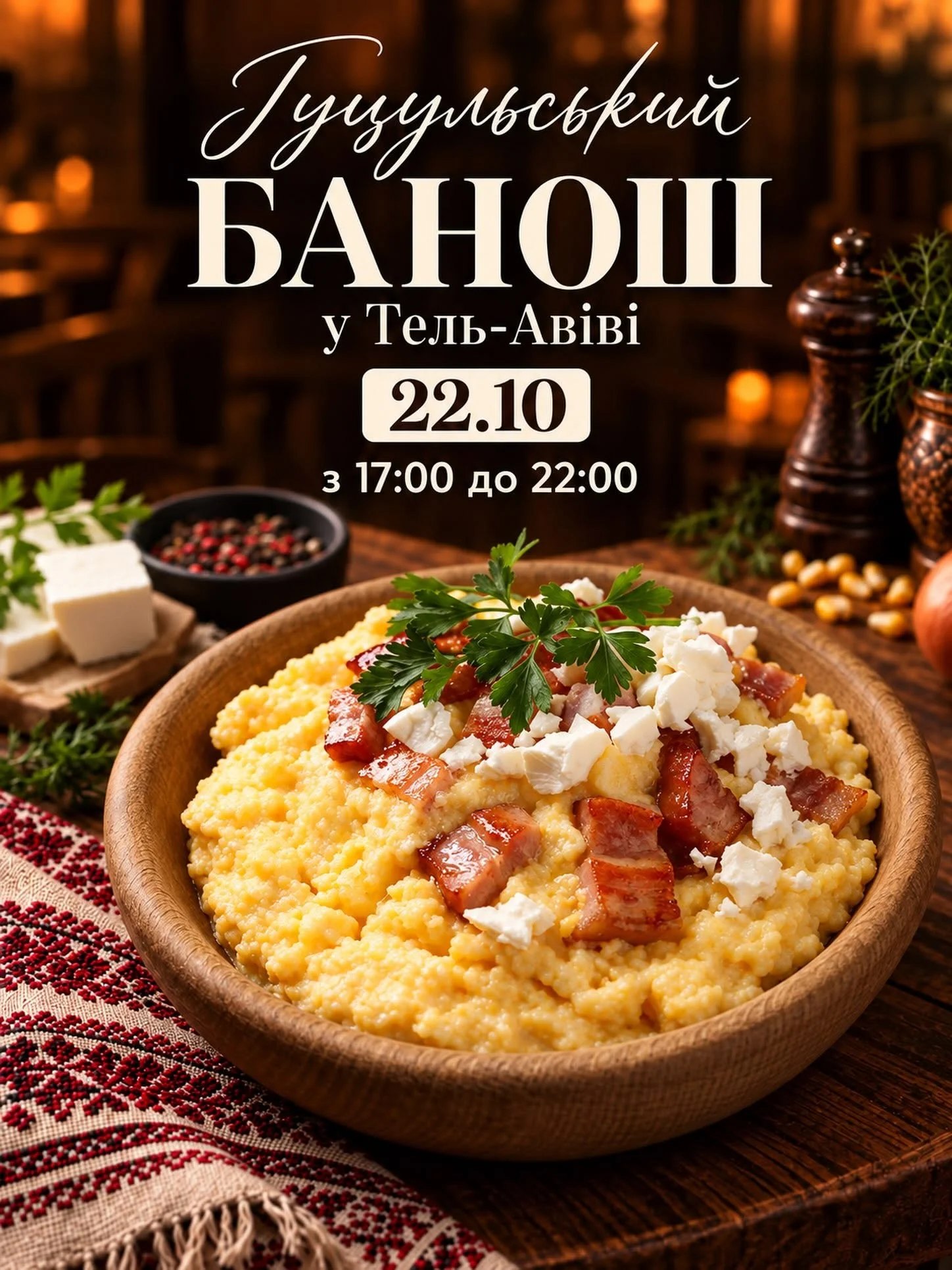
Banosh, or banush, is a traditional dish of Hutsul cuisine, made from corn grits cooked in rich sour cream or cream. Its feature is a tender, rich, slightly stretchy consistency, quite unlike ordinary porridge cooked in water.
The Hutsuls are an ethnographic group of Ukrainians living mainly in the Carpathians, primarily in the modern Ivano-Frankivsk, Zakarpattia, and Chernivtsi regions of Ukraine. They have preserved their own traditions, clothing, music, crafts, and cuisine.
In Carpathian villages, banosh was traditionally cooked in a cast-iron pot over an open fire. Corn grits were gradually added to hot sour cream and stirred with a wooden spoon until the porridge became thick and homogeneous.
The most important addition is brynza, a salty brined cheese traditionally made from sheep’s milk. Cracklings — small fried pieces of lard — and forest mushrooms were also often used.
Banosh was eaten in everyday life, prepared for family and guests. Over time, it has become one of the most recognizable gastronomic symbols of the Ukrainian Carpathians.
Six ways to prepare banosh: from classic to modern variations
There is no single recipe followed by all Hutsul families. Some prefer thicker porridge, some add more sour cream, and some believe that without the right brynza, banosh loses its character.
Classic banosh with brynza. Corn grits are cooked in rich sour cream, sometimes diluted with water. The finished dish is generously sprinkled with crumbled sheep brynza. This is the simplest way to taste the base itself — the combination of corn, creamy sourness, and salty cheese.
Banosh with Carpathian mushrooms. Porcini mushrooms or other forest mushrooms are fried with onions and added to the hot porridge. At home, champignons will also work. This is an aromatic option, especially popular among mushroom dish lovers.
Banosh with cracklings and brynza. One of the most famous traditional serving methods. Pieces of lard are rendered to a golden color, then added to the porridge along with brynza. It turns out to be an especially hearty dish.
Zakarpattia variant with cream. Instead of just sour cream, rich cream or a mixture with sour cream is used. Banosh becomes softer, with a pronounced creamy taste. It is complemented with butter and cheese.
Banosh with chicken and mushrooms. This is already a modern culinary interpretation. Fried chicken, mushrooms, and onions turn the corn base into a full-fledged hot dish. It’s important not to confuse this option with the historical Hutsul recipe.
Lean banosh with mushrooms. An adapted version without dairy products and meat. The grits are cooked in water or unsweetened plant-based drink, adding mushrooms, fried onions, and vegetable oil. It tastes different from the classic, but is suitable for those who follow a plant-based diet.
At the SHO? restaurant on October 22, traditional combinations are announced: brynza, mushrooms, cracklings, or all together. The other options are provided to introduce the variety of recipes, not as confirmed items on the festive menu.
Can you make real banosh at home?
Yes, you can. And you don’t need a Carpathian stove or an open fire for it.
For three servings, it’s enough to take 150 grams of corn grits, 400 grams of sour cream with a fat content of 20–25%, 150–200 milliliters of water, 100–120 grams of brynza, and a little salt.
Sour cream is mixed with water in a thick-walled pot and heated over low heat. Then the grits are gradually added, stirring continuously to prevent lumps.
Depending on the grind, cooking takes about 15–25 minutes. The finished banosh should be soft, creamy, without hard grains.
Salt is added carefully: brynza is quite salty on its own. In the end, the hot porridge is distributed onto plates and sprinkled with cheese. Mushrooms or cracklings are prepared separately.
There’s also a small secret: good banosh requires attention. You can’t just leave it on the stove and remember it in twenty minutes. Constant stirring is an important part of the preparation.
Why banosh in Tel Aviv is more than an unusual dinner
For people from Ukraine, traditional cuisine often becomes one of the simplest ways to maintain a connection with their native places.
And it’s not just about a specific dish. Behind it are family stories, memories of cities and villages, trips to the Carpathians, and large family feasts.
For the Israeli audience, there is another historical context here. Galicia, Bukovina, and Zakarpattia were regions where Ukrainians, Jews, and other peoples lived side by side for centuries. Their daily lives intersected in markets, cities, and small settlements.
This does not mean that banosh has Jewish origins. It remains a Hutsul dish. But getting to know Carpathian cuisine helps to better understand the region, which is connected to the history of many Jewish families living in Israel today.
Such cultural meetings are already becoming a noticeable part of the life of the Ukrainian community in the country.
NANovosti previously reported on how the SHO? restaurant celebrated its third anniversary in Tel Aviv, as well as on the performance of the Ukrainian rock band Chornitsa from Haifa at this venue.
These events are interesting not only to Ukrainians. They are an opportunity for Israelis to get acquainted with modern Ukrainian culture without political declarations — through music, conversation, and food.
NANovosti — News of Israel | Nikk.Agency continues to report on such meetings, as it is through ordinary human communication that understanding between the societies of Israel and Ukraine often arises.
Banosh and kashrut: what Israeli guests should know
Traditional banosh has a feature important for those observing kashrut.
The classic version with pork cracklings is not kosher. Moreover, the combination of meat products with a dairy base also does not comply with kashrut rules.
Banosh with brynza and mushrooms does not contain meat, but this alone does not guarantee the dish’s kosher status: the origin of the ingredients, preparation conditions, and the presence of appropriate supervision are important.
The version with chicken and mushrooms can be adapted to a meat kosher menu if the corn base is prepared without dairy products and other kashrut requirements are observed.
Visitors for whom this is significant should clarify the dish’s composition and the kitchen’s status in advance with the SHO? restaurant. The organizers have not announced kosher certification for the evening.
Who will welcome guests on October 22
The organizers decided to emphasize not only the gastronomic but also the cultural side of the evening.
In traditional Ukrainian attire, guests will be welcomed by three women:
Anna Andrienko (Anna Andrienko) — the owner of the SHO? restaurant, who will personally greet visitors.
Lyudmila Polenok (Ora) — a participant in the evening, well-known to the organizers and guests of the establishment.
Maria Geshko (Masha Geshko) — another participant in the festive meeting.
The SHO? announcement emphasizes that the main thing is to give people the opportunity not only to try banosh but also to feel the atmosphere of a Ukrainian feast, where guests are welcome and no one is rushed away from the table.
And perhaps this is what makes the evening interesting. Ukrainian cuisine in the center of Tel Aviv ceases to be just a restaurant menu and turns into a live meeting with the traditions of another country.
Where and when to try Hutsul banosh in Tel Aviv
Date: Thursday, October 22, 2026.
Time: from 5:00 PM to 10:00 PM.
Place: SHO? – Ukrainian Traditional Food.
Address: Carlebach Street 3, Tel Aviv–Yafo.
Phone for reservations: 058-607-6070.
What will be offered: banosh with brynza, mushrooms, cracklings, or all toppings at once.
Cost: not specified in the published announcement. The price of dishes and ordering conditions should be checked with the organizers.
Details and ordering: official event post on Facebook.
Additional information — on the SHO? – Ukrainian Traditional Food page.
The evening is open to those who already know the taste of banosh and to those who hear this word for the first time.
On October 22, in the center of Tel Aviv, you can get acquainted with Hutsul cuisine without a trip to the Carpathians. And perhaps, at the same time, discover a part of Ukrainian culture that you previously knew almost nothing about.